 Add to Chrome
 Add to Firefox
 Add to Edge
PhyScene3D: Physically Consistent Interactive 3D Tabletop Scene Generation
Jun 01, 2026
Generating physically consistent 3D tabletop scenes is a fundamental yet underexplored problem for interactive and generalist robotic learning. The challenge stems from dense object hierarchies and irregular affordances. Here, an interactive scene denotes a physically valid, collision-free environment directly loadable into physics simulators. Existing methods, ranging from decoupled symbolic solvers to end-to-end regression models, often suffer from error propagation or overfitting to noisy supervision containing widespread physical violations. To address these limitations, we introduce PhyScene3D, a framework that reformulates generation as a Human-Mimetic Constructive Process. The proposed Cognitive Topological Reasoning Chain (CTRC) factorizes scene synthesis into a sequential, anchor-conditioned process. It employs a 3D AABB-based placement scheme that imposes a strong structural inductive bias. To address imperfect supervision and physical infeasibility, we introduce Physics-Aware Denoising Alignment (PADA). It integrates a differentiable Signed Distance Field (SDF) with Test-Time Optimization (TTO) to project generated scenes onto a physics-feasible manifold while preserving semantic intent. Experiments demonstrate that PhyScene3D outperforms state-of-the-art approaches in both semantic accuracy and physical validity, achieving a 40% reduction in scene-wise collision rate relative to the human-annotated training data.

Gated Graph Attention Networks with Learnable Temperature
May 28, 2026Graph attention networks learn neighbor importance through data-dependent coefficients, but standard layers lack explicit control over unreliable feature dimensions and use fixed sharpness of attention coefficient distributions. This paper proposes gated graph attention and learnable temperature for common graph attention mechanisms. Gated graph attention filters feature or message responses to reduce the influence of unreliable dimensions, while learnable temperature dynamically adjusts the sharpness of the attention coefficient distribution. Experiments on homogeneous and heterophilic heterogeneous benchmarks show that the proposed variants consistently improve the corresponding graph attention backbones, and controlled noise studies further verify their behavior under feature perturbations. Theoretical analysis explains these results by showing that gating improves robustness when only part of the feature coordinates are reliable, while temperature is beneficial when global noise weakens the discriminability of node features.
Misclassification Rate and Privacy-Utility Trade-offs in Graph Convolutional Networks via Subsampling Stability
May 03, 2026We study differential privacy (DP) in Graph Convolutional Networks (GCNs) through the framework of \textit{subsampling stability}. We derive upper bounds on the misclassification rate that depend explicitly on the subsampling probability $p_s$. Furthermore, we characterize the \textit{privacy--utility trade-off} by identifying feasible ranges of $p_s$; if $p_s$ is too large, the stability-based privacy condition becomes difficult to satisfy, yielding vacuous guarantees, whereas if it is too small, accuracy deteriorates. Our results provide the first rigorous theoretical framework for understanding subsampling stability in GCNs under DP.
SafeWork-R1: Coevolving Safety and Intelligence under the AI-45$^{\circ}$ Law
Jul 24, 2025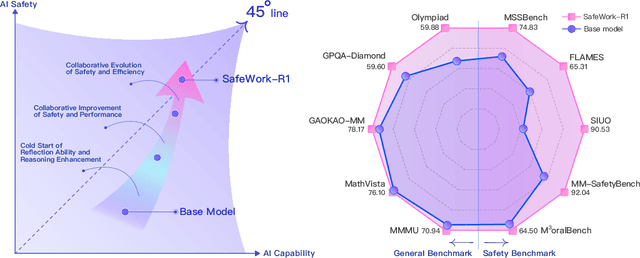
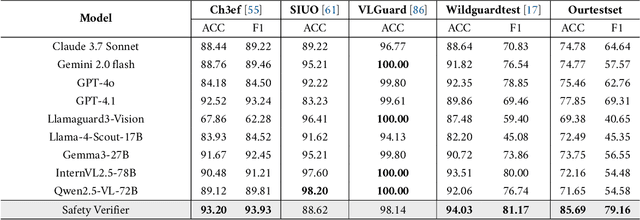
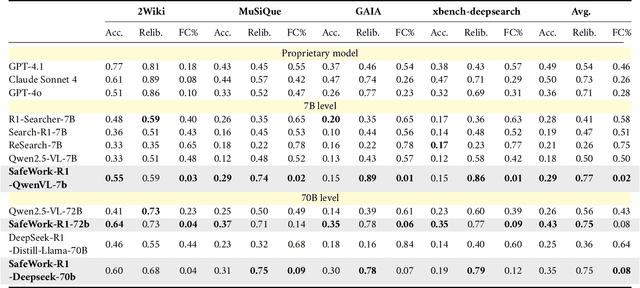
We introduce SafeWork-R1, a cutting-edge multimodal reasoning model that demonstrates the coevolution of capabilities and safety. It is developed by our proposed SafeLadder framework, which incorporates large-scale, progressive, safety-oriented reinforcement learning post-training, supported by a suite of multi-principled verifiers. Unlike previous alignment methods such as RLHF that simply learn human preferences, SafeLadder enables SafeWork-R1 to develop intrinsic safety reasoning and self-reflection abilities, giving rise to safety `aha' moments. Notably, SafeWork-R1 achieves an average improvement of $46.54\%$ over its base model Qwen2.5-VL-72B on safety-related benchmarks without compromising general capabilities, and delivers state-of-the-art safety performance compared to leading proprietary models such as GPT-4.1 and Claude Opus 4. To further bolster its reliability, we implement two distinct inference-time intervention methods and a deliberative search mechanism, enforcing step-level verification. Finally, we further develop SafeWork-R1-InternVL3-78B, SafeWork-R1-DeepSeek-70B, and SafeWork-R1-Qwen2.5VL-7B. All resulting models demonstrate that safety and capability can co-evolve synergistically, highlighting the generalizability of our framework in building robust, reliable, and trustworthy general-purpose AI.
Understanding When and Why Graph Attention Mechanisms Work via Node Classification
Dec 20, 2024Despite the growing popularity of graph attention mechanisms, their theoretical understanding remains limited. This paper aims to explore the conditions under which these mechanisms are effective in node classification tasks through the lens of Contextual Stochastic Block Models (CSBMs). Our theoretical analysis reveals that incorporating graph attention mechanisms is \emph{not universally beneficial}. Specifically, by appropriately defining \emph{structure noise} and \emph{feature noise} in graphs, we show that graph attention mechanisms can enhance classification performance when structure noise exceeds feature noise. Conversely, when feature noise predominates, simpler graph convolution operations are more effective. Furthermore, we examine the over-smoothing phenomenon and show that, in the high signal-to-noise ratio (SNR) regime, graph convolutional networks suffer from over-smoothing, whereas graph attention mechanisms can effectively resolve this issue. Building on these insights, we propose a novel multi-layer Graph Attention Network (GAT) architecture that significantly outperforms single-layer GATs in achieving \emph{perfect node classification} in CSBMs, relaxing the SNR requirement from $ \omega(\sqrt{\log n}) $ to $ \omega(\sqrt{\log n} / \sqrt[3]{n}) $. To our knowledge, this is the first study to delineate the conditions for perfect node classification using multi-layer GATs. Our theoretical contributions are corroborated by extensive experiments on both synthetic and real-world datasets, highlighting the practical implications of our findings.
Community Detection in the Multi-View Stochastic Block Model
Jan 17, 2024This paper considers the problem of community detection on multiple potentially correlated graphs from an information-theoretical perspective. We first put forth a random graph model, called the multi-view stochastic block model (MVSBM), designed to generate correlated graphs on the same set of nodes (with cardinality $n$). The $n$ nodes are partitioned into two disjoint communities of equal size. The presence or absence of edges in the graphs for each pair of nodes depends on whether the two nodes belong to the same community or not. The objective for the learner is to recover the hidden communities with observed graphs. Our technical contributions are two-fold: (i) We establish an information-theoretic upper bound (Theorem~1) showing that exact recovery of community is achievable when the model parameters of MVSBM exceed a certain threshold. (ii) Conversely, we derive an information-theoretic lower bound (Theorem~2) showing that when the model parameters of MVSBM fall below the aforementioned threshold, then for any estimator, the expected number of misclassified nodes will always be greater than one. Our results for the MVSBM recover several prior results for community detection in the standard SBM as well as in multiple independent SBMs as special cases.